
The 2027 Medicare Physician Fee Schedule:
Is CMS Signaling the Future of Home-Based Primary Care?
By Dr. Paul Chiang
The Centers for Medicare & Medicaid Services (CMS) recently released the proposed 2027 Medicare Physician Fee Schedule, and it goes beyond routine updates. It doubles as a roadmap for where CMS envisions primary care over the next decade.
For home-based primary care (HBPC) practices, several proposed changes could significantly affect reimbursement, operations, and participation in value-based care. Equally important, CMS included a broad request for information (RFI) seeking input on the future of primary care payment itself.
Although these proposals are not yet final, they deserve careful attention from the HBPC community.
Why the Rule Matters for Home-Based Primary Care
Taken together, the proposed changes, which include a G2211 transition, MSSP enhancements and benchmark reform, MVP expansion, and primary care redesign discussions, indicate that CMS is increasingly aligning financial incentives toward clinicians who combine longitudinal relationships with accountability for quality, utilization, and total cost of care. If these changes lead to new Medicare policy over the next decade, HBPC may be better positioned for success than many traditional primary care models.
Proposed Changes at a Glance
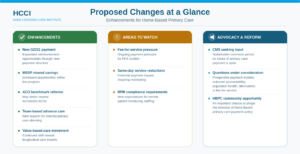
Enhancements for Home-Based Primary Care
- Expanded reimbursement opportunities through a new G2211 payment structure
- Increased shared savings opportunities within MSSP
- Benchmark reforms that may better reward successful ACOs
- New support for team-based advance care planning
- Continued movement toward value-based, longitudinal care models
Areas Requiring Attention
- Ongoing fee-for-service payment pressure
- Potential impact of same-day service payment reductions
- New RPM compliance and staffing expectations
Advocacy and Future Payment Reform
- CMS is seeking stakeholder input on the future of primary care payment.
- Questions under consideration include prospective payment models, accountability for outcomes, prevention, population health, and alternatives to traditional fee-for-service reimbursement.
- The HBPC community has an important opportunity to influence these discussions.
A Closer Look at the Proposed Changes
Proposed Reduction in the Physician Conversion Factor
As expected, CMS proposed another reduction in the Medicare Physician Fee Schedule conversion factor. Like recent years, this continues to place pressure on traditional fee-for-service reimbursement.
For HBPC practices that rely primarily on Medicare home visits, declining conversion factors reinforce an important reality: fee-for-service alone is becoming increasingly difficult as a long-term business model.
Practices may need to rely more heavily on Advanced Primary Care Management (APCM), value-based contracts, Medicare Advantage partnerships, accountable care organizations (ACOs), and shared savings to offset continued erosion in fee-for-service revenue.
Same-Day E/M and Procedures May Face Reduced Payment
CMS proposes a new multiple-procedure payment adjustment for separately identifiable outpatient E/M services furnished on the same day as certain 0-, 10-, or 90-day global procedures. Under the proposal:
- The highest-valued service would be paid at 100% of the fee schedule amount.
- Additional qualifying E/M or procedural services performed on the same day would generally be paid at 50%.
For HBPC practices that routinely combine home visits with procedures such as joint injections, wound procedures, this could reduce reimbursement for same-day services.
Practices may wish to analyze historical claims data to estimate potential financial impact.
Team-Based Advance Care Planning Codes
Beyond extending existing telehealth flexibilities, CMS also made a notable change to Advance Care Planning (ACP) reimbursement. The agency proposed two new HCPCS codes describing ACP services furnished by clinical staff under the supervision of the billing physician or practitioner.
If finalized, these codes could support a more team-based approach to advance care planning by recognizing the role of nurses and other clinical staff in facilitating goals-of-care discussions while maintaining physician or practitioner oversight.
Additional CMS guidance and the final rule will be important in determining exactly how these services may be delivered and supervised.
For HBPC practices that routinely care for patients with advanced illness or multiple chronic conditions, the proposal could better align payment with the interdisciplinary nature of serious illness communication. This represents a potentially meaningful expansion of how Medicare recognizes and reimburses team-based ACP services.
The End of G2211?
One of the most significant proposals is CMS's plan to transition G2211 from a standalone add-on code to a modifier-based payment adjustment that would increase reimbursement for qualifying longitudinal care services based on a percentage of the underlying evaluation and management (E/M) service. Under the proposal:
- Most qualifying clinicians would receive a 16% payment boost for eligible longitudinal E/M services.
- Clinicians participating in a Medicare Shared Savings Program (MSSP) ACO or LEAD ACO would qualify for an enhanced 32% payment increase.
For HBPC practices caring for medically complex, chronically ill patients, this is noteworthy. Higher-level home visits (such as CPT 99349 and 99350) could receive substantially larger payment increases than they do under today's flat G2211 add-on.
CMS appears to be shifting payment from simply recognizing longitudinal relationships to rewarding both longitudinal care and accountability for outcomes.
Traditional MIPS Continues Its Transition Toward MVPs
CMS also continued its effort to simplify physician quality reporting. The proposal advanced the gradual sunset of traditional Merit-based Incentive Payment System (MIPS) reporting while moving clinicians toward Merit-based Incentive Payment System Value Pathways (MVPs).
Many clinicians have long felt that traditional MIPS measures inadequately reflect the complexity of caring for frail older adults and medically homebound patients. Specialty-focused MVPs may ultimately provide a better fit for HBPC practices.
Although the transition will occur over several years, HBPC practices should begin planning now.
Remote Patient Monitoring Faces New Operational Requirements
Another proposal receiving significant attention involves Remote Patient Monitoring (RPM). CMS suggested additional guardrails around the use of third-party RPM companies and seemed to emphasize that RPM services should remain under the direct operational and clinical oversight of the billing practice. Organizations relying heavily on turnkey vendor models may need to reassess workflow, staffing, and compliance structures.
For some HBPC practices, this could represent one of the more significant operational changes in the rule.
Better Opportunities for Accountable Care Organizations
The proposed rule contained several changes that strengthen participation in the Medicare Shared Savings Program (MSSP), including:
- Increasing Basic Track E maximum shared savings from 50% to 60%
- Reforming ACO benchmarking methodology to reduce the long-recognized "success penalty" that occurs when historically successful organizations receive increasingly difficult benchmarks after each agreement period
These proposals are particularly relevant for HBPC. Because home-based primary care consistently demonstrates reductions in hospitalizations, emergency department utilization, skilled nursing facility use, and total cost of care, more stable benchmarks and higher shared savings percentages could significantly improve the long-term business case for participating in MSSP.
Perhaps the Most Important Part of the Rule: The Request for Information
Ironically, the most important section of the proposed rule may not change payment in 2027 at all.
CMS included several requests for information and discussion sections that signal ongoing interest in redesigning physician payment and strengthening primary care. Rather than focusing solely on annual payment updates, CMS seeks feedback on broader questions involving longitudinal care, accountable care, population health management, physician payment reform, and alternatives to traditional fee-for-service reimbursement.
These discussions suggest CMS is exploring whether Medicare should rely less on isolated visit-based payment and place greater emphasis on accountability for patient outcomes, total cost of care, preventive services, and population health management.
While CMS is not proposing a national primary care capitation model or per-member per-month (PMPM) payment system in the 2027 proposed rule, the questions being raised may provide insight into the agency's long-term thinking regarding future primary care payment models.
Questions for the HBPC Community
The proposed rule raises several important questions that deserve discussion:
- Does HBPC create enough value outside of face-to-face visits that prospective population-based payment may be a better fit than traditional fee-for-service reimbursement?
- If CMS offered a risk-adjusted monthly payment for your HBPC patients, would you prefer that model over relying primarily on visit-based reimbursement? Why or why not?
- Are MSSP ACOs creating meaningful opportunities for HBPC practices, or are they shifting too much financial risk onto providers?
- Will replacing G2211 with a percentage-based payment adjustment better recognize the value of longitudinal care for medically complex patients?
- How would the proposed RPM staffing requirements affect your practice?
- What payment model best supports comprehensive home-based care: fee-for-service, APCM plus fee-for-service, shared savings, capitation, or another approach?
- HBPC providers are uniquely positioned to deliver multiple services during a single home visit. Could reducing the second service payment to 50% discourage clinicians from providing procedures during an otherwise necessary home visit?
We Want Your Feedback
Whether these proposals are finalized as written or modified after public comment, they suggest continued movement toward prospective payment, longitudinal care, value-based accountability, and population health management.
For HBPC providers, this could represent either a significant opportunity or a significant challenge.
We encourage you to review the proposed rule, discuss its implications with colleagues, and share your perspectives. The future of primary care payment is being defined, and the voice of the HBPC community should be part of that conversation. Email your feedback and comments to info@hccinstitute.org.
About Home Centered Care Institute
Home Centered Care Institute (HCCI) is a national nonprofit dedicated to expanding access to home-based primary care for the country’s most medically complex and vulnerable patients. Through education, training, and advocacy, HCCI equips providers and practices with the knowledge and tools needed to deliver high-quality care in the home.