
Coauthored by: Aaron Yao and Heidi Ruhe
Together, we have watched Medicare change how it pays for the sickest, most complex patients, and home-based primary care (HBPC) is emerging as one of the clearest ways to meet the moment. And things continue to change. CMS's new LEAD model, replacing ACO REACH in 2027, extends and standardizes financial accountability for high-needs beneficiaries. On the Medicare Advantage side, the same shift is underway: enrollment in Special Needs Plans, built specifically around high-needs populations, continues to grow rapidly. Both markets are moving toward the same patients, two sides of the same coin.
The research on HBPC is remarkably consistent: patients who receive primary care at home end up in the hospital less often, and cost less to care for. A Washington, DC program that sent doctors and nurse practitioners into patients' homes cut total Medicare spending by 17%, about $8,500 per patient over two years, while its patients had 9% fewer hospital stays than similar patients who got usual care. The VA, which runs the largest HBPC program in the country, saw hospital admissions fall by a quarter among enrollees, with savings that held up even after paying for the program itself. These aren't pilot programs or projections; they are results from tens of thousands of real patients.
And the data keeps confirming what's showing up in the field. Powered by Confer Analytics®, our research using 2025 claims data across hundreds of ACOs shows the same pattern playing out today: organizations that reach more of their high-needs patients with HBPC tend to have fewer hospital stays in that population. But the more striking finding is how few patients are being reached at all. The typical ACO delivers HBPC to less than 10% of its high-needs patients, the very people who cost roughly five times as much as everyone else. Meanwhile, the ACOs built specifically around high-needs populations reach half or more of their patients at home, showing what's operationally possible. Click here to see how ACOs by type (e.g., MSSP, REACH, etc.) perform differently on hospitalization rates by % of high needs patients:
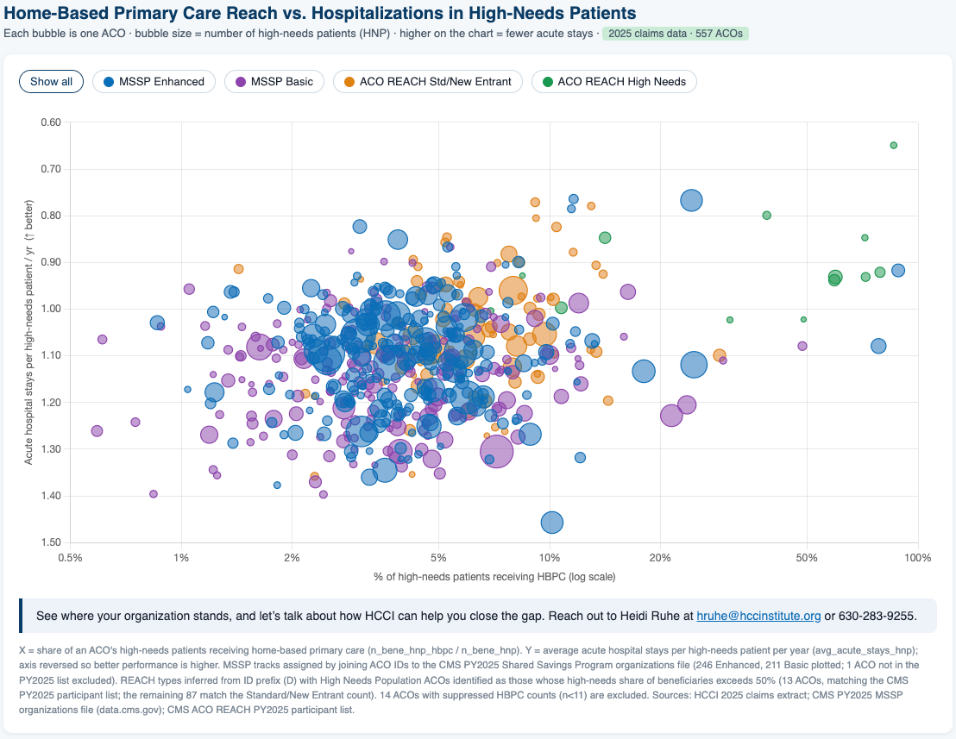
As LEAD reshapes how this population is measured and paid for, this is the largest pool of avoidable cost still sitting on the table for most ACOs: a proven care model, a clearly identified patient population, and most of the opportunity still unclaimed.
HCCI counts you among our best advocates for advancing HBPC. Could an organization or provider you know benefit from HCCI's help? To see where your organization stands in these results or otherwise talk about how HCCI can help, please reach out to Heidi Ruhe at hruhe@hccinstitute.org or 630-283-9255.